
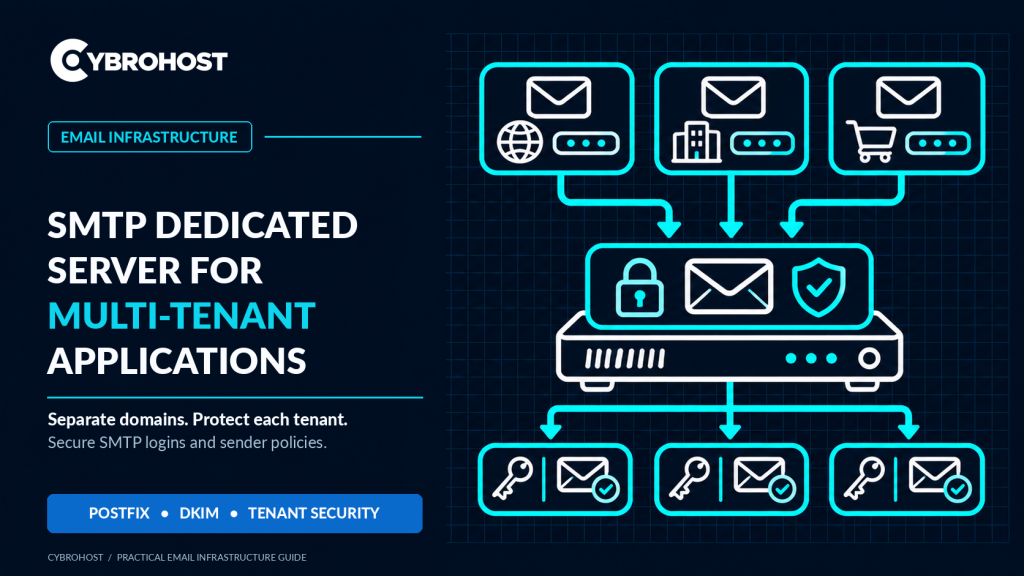
An SMTP dedicated server for multi-tenant applications lets several businesses or apps send legitimate email from one physical machine. However, dedicated hardware does not automatically isolate those tenants. Without sender controls, one compromised application could impersonate another domain or damage a shared sending IP’s reputation.
Multi-Tenant SMTP Dedicated Server: What Must Be Isolated?
| Layer | Recommended separation |
|---|---|
| SMTP access | One authenticated account per tenant or application |
| Sender identity | Approved envelope and visible From addresses |
| DNS authentication | SPF, DKIM keys, and DMARC per sending domain |
| Abuse controls | Per-tenant limits, logs, and account suspension |
1. Assign Individual SMTP Credentials
Create a separate credential for each shop, CRM, or customer portal. Use authenticated submission on port 587 with required STARTTLS or 465 with implicit TLS. Store secrets securely, rotate compromised passwords, and prohibit unauthenticated relaying.
Don’t reuse an administrator’s SMTP login across customers. Tenant accounts should never receive shell or root access merely to send mail.
2. Restrict Sender Addresses in Postfix
A valid SMTP login should not grant permission to send as every hosted domain. Postfix supports smtpd_sender_login_maps to associate envelope sender addresses with specific authenticated identities.
For example, a controlled sender map might contain:
orders@alpha.example  tenant-alpha
alerts@beta.example  tenant-beta
Build the lookup database using postmap, then enforce reject_authenticated_sender_login_mismatch on the authenticated submission service. The official Postfix SASL guide explains the required restrictions.
Important: This protects the SMTP envelope sender. Restricting the visible From: header requires an additional policy filter or Milter.
3. Authenticate Every Tenant Domain
Publish SPF for authorized sending IPs, sign each domain with its own DKIM key, and configure DMARC alignment and reporting. Use separate DKIM selectors and restrict access to private keys. Check forward DNS and PTR/rDNS for each outgoing IP.
A valid record does not guarantee inbox delivery; test headers and recipient responses for each tenant.
4. Enforce Quotas and Monitor Abuse
Set sensible message-rate and recipient limits per account through a suitable policy service or MTA configuration. Monitor failed logins, bounces, spam complaints, and unusual sending spikes. Give administrators a way to suspend one tenant without interrupting the others.
Multiple tenants may still share a Postfix queue and public IP. Separate credentials and DKIM keys do not isolate IP reputation. Higher-risk customers may need distinct IPs, MTA instances, or servers.
5. Protect Data and Plan Recovery
Keep tenant credentials, configuration files, logs, and signing keys access-controlled. Encrypt backups, test restoration, and alert on queue growth or disk pressure. Patch the operating system and mail stack regularly.
Compare CybroHost dedicated servers for CPU, RAM, and storage capacity. Confirm outbound port 25, PTR support, additional IP availability, and acceptable-use requirements for your chosen configuration before ordering.
FAQs
Can multiple domains use one SMTP dedicated server?
Yes. Each domain can use separate credentials and authentication records, provided sender permissions are enforced.
Does every tenant need a separate IP?
No. Separate IPs can reduce reputation coupling, but shared infrastructure still needs per-tenant abuse controls.
Is a dedicated server enough for tenant security?
No. Hardware isolation from other customers does not replace account permissions, sender checks, monitoring, or recovery procedures.
Final Recommendation
Build tenant isolation into SMTP authentication, sender identity, DNS, and monitoring. Use stronger queue or IP separation when a tenant’s risk or traffic justifies it.
